Graveyard Keeper 2 Beginner Guide — Your First Week
What to do first in Graveyard Keeper 2: the three-stage opening route, a first-week day plan, technology priorities, tired rules and your first zombie.
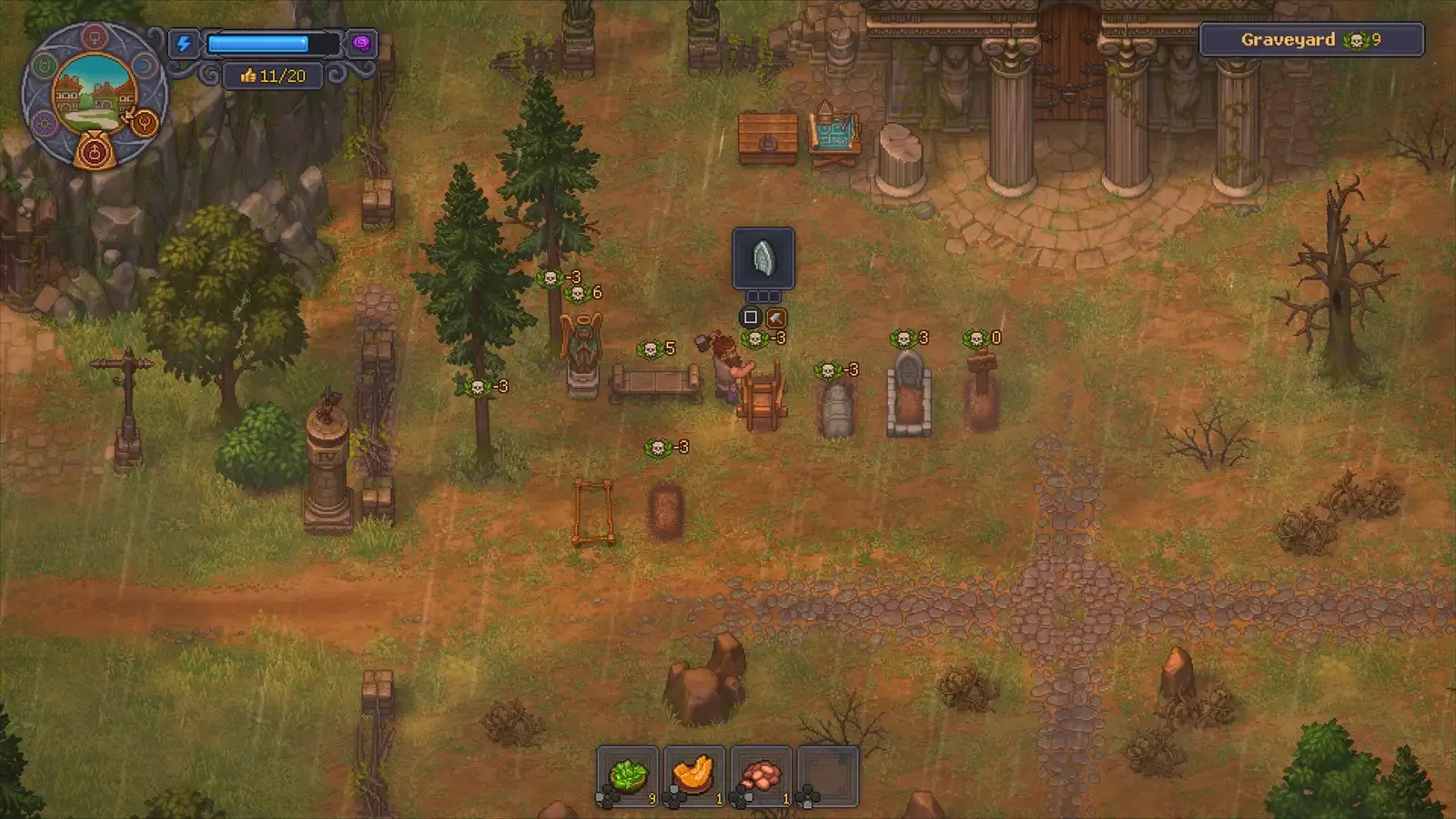
What should you do first in Graveyard Keeper 2?
The opening of Graveyard Keeper 2 follows three stages. First, bury the corpse from the prologue and take the burial certificate to Herbert at the Crossroads. Second, establish food, basic materials and a fishing rod. Third, open the Church, reach church quality 10 and hold your first sermon on a Wrath day.
Stage one is short. Showing Herbert the Burial Certificate completes Certificate, Please: the village gate opens, the donkey starts delivering corpses regularly, and you gain 10 Herbert reputation. Before that quest the guards turn you away. The follow-up, Grave Expectations, pays another 10 Herbert reputation for graveyard quality 10.
Stage two is where most of the first week goes. You need a food chain (Gardening, then Millstone and Bread), a wood chain (The Concept of Wood, Chopping, Woodworking I) and a fishing rod. The rod comes from the twins south of the village, and Pottery I unlocks the Clay Plate that the fishing and quest lines ask for.
Stage three is the Church. The chain runs through Herm and the twins, who need 5 Wooden Plank and 5 Bronze Detail for Jack in a Boat. Bronze Detail requires Bronze Works, and the anvil needs a Hardening Bucket extension beside it for those parts. Once Jack’s boat leaves, sleep, read his letter, meet the Nun at the Village Tavern and take Holy Moly!. Church quality 10 comes from clearing obstructions and building Interior Bench seats; each costs 2 Wooden Plank and 6 Bronze Nails across six slots.
The full sequence sits in our main quest order page, and Herbert’s own chain is broken down in the Herbert quest line guide.
What does the first week look like, day by day?
A Graveyard Keeper 2 week is six days, shown only as glyphs: Gluttony, Sloth, Lust, Envy, Pride and Wrath. Only a few systems are day-locked early, so the plan below uses those days as anchors and fills the rest with wood, stone and food work.
| Day (glyph) | Goal | Why |
|---|---|---|
| Gluttony | Bury the prologue corpse, then take the Burial Certificate to Herbert at the Crossroads | It completes Certificate, Please: the village opens, corpse deliveries start and you gain 10 Herbert reputation |
| Sloth | Wood day: The Concept of Wood, Chopping, Woodworking I, then Board and Wooden Plank | Sloth only gates battles, and you have no battle to fight yet; every early building needs planks |
| Lust | Recover the fishing rod from the twins, unlock Pottery I, plant your first Garden Bed | Lust only gates the port ship, Linda’s Green Scrolls and Davy’s orders; crops need days to grow |
| Envy | Food and stone work: finish the stone chain and your first graves | Envy is the day the Resurrection Lab has power, which you do not need yet because your first zombies come from quests |
| Pride | Bank Gratitude: Burial Certificates to Januarius, Likes-tagged goods to Herm | Pride is when town orders open and each merchant’s weekly Likes cap resets |
| Wrath | Hold a sermon if the Church is open; otherwise push the church repair chain | Wrath is the only day a sermon can be held, and sermons are the only source of Faith |
The weekly Gratitude ceiling matters: selling Burial Certificates to Januarius is capped at roughly 5 Gratitude per week and one sermon spends 10, so a single source never covers a sermon. Church mechanics are covered in church and sermons.
Which technologies should you unlock first?
Put wood and stone first, then food, then the writing line. The Concept of Wood (2 red points plus 2 green) unlocks Board, Short Log and Sawhorse; Woodworking I (10 red) unlocks Wooden Plank; The Concept of Stone (15 red) unlocks Piece of stone. Pottery and fishing come after that.
There is no widely cited community unlock ranking for Graveyard Keeper 2. Every “best technologies first” list we could find was written for the first game and its older numbers, so it does not transfer. The order below is this site’s recommendation built from the mechanics, not a community ranking.
- The Concept of Wood — 2 red plus 2 green. The cheapest node in the tree and the gate to every plank.
- Woodworking I — 10 red. Wooden Plank is the most reused early intermediate.
- The Concept of Stone — 15 red. Piece of stone and the Stonemason’s Workbench.
- Chopping — 8 red. Firewood and Wood wedge.
- Pottery I — 10 red plus 5 green. Clay Plate, and the route into fishing.
- Wooden Gravestones I — 5 red plus 2 green. Wooden Cross I scores 2 and Wooden Fence I scores 1, so four graves reach graveyard quality 10.
- Gardening (5 green), Millstone (5 red plus 10 green), Bread (25 green). The food and energy loop.
- Bronze Works (5 red), Bronze Melting (10 red), Bronze Craft (30 red). Jack’s materials need 5 Bronze Detail.
- Writing Basic (5 red plus 5 green), Writing Supplies (10 red plus 5 blue). Opens the blue point economy and Science Kit I.
- Tool Rack — 35 red. Four hotbar slots run out fast, and it is the road to zombie automation.
Blue points are the bottleneck this order is built around. Your first blue points come from researching items at the Study Table in the church basement, and research also reveals each item’s alchemy runes, so it pays twice. The wider point economy is covered in tech points farming, and the node-by-node shape is in the tech tree overview.
When should you get your first zombie?
Your first zombies arrive for free from quests, not from the resurrection lab. The Plague Doctor hands over two during Sweet Dreams, and Gunter gives three more through Friendship Written in the Stars once his reputation reaches 10. They will do nothing useful until you give them tools.
Zombies start with zero mastery in all five lines, and even basic recipes demand one or two levels, so an unarmed worker stands idle. Tools supply the missing mastery for one specific line: a rusty axe adds 1 Building, a bronze axe adds 2, and a bronze shovel adds 2 Farming.
Automation therefore has a floor. Zombie Assistant costs 35 red plus 5 green and unlocks the Zombie Supplier Station, behind Tool Rack at 35 red. Until then the community view holds up: the zombie line is a poor early goal because the tool and mastery overhead eats the profit. Start real automation once you have Tool Rack, a spare zombie and a supplier. Read how to get zombie workers first.
How do tired and insanity reshape your daily rhythm?
Tired is not an empty energy bar. It appears after roughly two consecutive game days without sleeping, showing a blue Zz bubble. While tired, every point of energy you spend adds 0.5 insanity and all insanity-reducing items work at half strength, so the state compounds quickly.
Insanity is the second bar and it cuts your energy ceiling directly: maximum energy is 100 minus insanity, with insanity capped at 80. The Iron Will perk lowers that cap to 70. This is why eating fills the current bar but never restores the ceiling, and why an ordinary night’s sleep does not lower insanity at all.
Sleeping to full energy while tired ends Lack of sleep and removes 20 insanity in one go. That is the only reliable free reduction, so the efficient loop is to work until the Zz appears and then sleep. Berry Pie is the cheap field fix: six berries and four dough make four pies, each giving 30 energy and removing 3 insanity. Three berry bushes sit near the house and five more in the village, so gathering on the way past costs nothing.
Energy also shapes each day. Researching an item costs 6 to 32 energy, or 2 to 14 with the Researcher perk, and long crafting chains cost more than short ones. Eat before a research or crafting block, not after. The numbers are on energy and insanity.
What are the most common first-week wastes?
The most expensive early mistakes are spreading tech points across decorative nodes, spending Faith that Herbert’s Fighting Spirit Required quest needs, and selling materials you have not researched yet. Research is the main source of green and blue points, and it also reveals the alchemy runes.
- Buying decoration nodes first. Fences and ornaments do not cut wood, and wood and stone gate everything else.
- Pre-buying technologies before you hit a wall. Quests pull new characters and systems into the game, and some nodes are reputation-gated rather than point-gated: Reinforced Plank needs 20 Herbert reputation.
- Spending Faith carelessly.
Fighting Spirit Requiredconsumes 3 Faith, and Faith also pays for milestones, inspirations and collars. It comes only from sermons, one per Wrath day, so overspending costs a week. - Upgrading the Church but not Gratitude. Sermon attendance is the lower of Likes and church quality, and Gratitude starts capped at 10 until the first town battle.
- Wasting Gratitude headroom. Gratitude does not carry between weeks, so high-tier prayers burn resources you cannot bank.
- Selling materials before researching them. Every item dumped without research is a lost tech point and a lost rune, and blue points are the scarcest colour.
- Stacking graveyard decoration on weak graves. Trees and empty plots score negative, and a grave’s score is capped by its white skulls, so heavy decoration cannot push a poor corpse past its own limit.
The graveyard scoring side sits with corruption and red skulls.
Related Articles
guides
Graveyard Keeper 2 Sauna — Pre-Order Bonus Explained
The Graveyard Keeper 2 Sauna is a pre-order bonus, not an in-game unlock. Where it sits, what the Steamed Up buff does, and every pre-order reward.
tech-tree
Graveyard Keeper 2 Energy and Insanity — Why You Are Tired
Why Graveyard Keeper 2 makes you tired, how insanity lowers your maximum energy, and the exact energy and insanity values of every consumable.
tech-tree
Graveyard Keeper 2 Tech Points — How to Get Red, Green and Blue
Every source of red, green and blue tech points in Graveyard Keeper 2, why red is the bottleneck, and how to pay for Study Table research with Science.
Was this helpful?
Thanks for the feedback!